
If you’re researching a ServSafe instructor salary before deciding whether to get certified, here’s the honest answer first: there’s no such thing as a standalone “ServSafe Instructor” job. You won’t find companies hiring for that exact title. The certification shows up as a requirement inside postings for other jobs — Training Manager, Restaurant Manager, HR Coordinator, Culinary Instructor, Health & Safety Lead. Teaching the ServSafe course is one piece of a bigger role, not the role itself.
Why the Numbers Don’t Agree
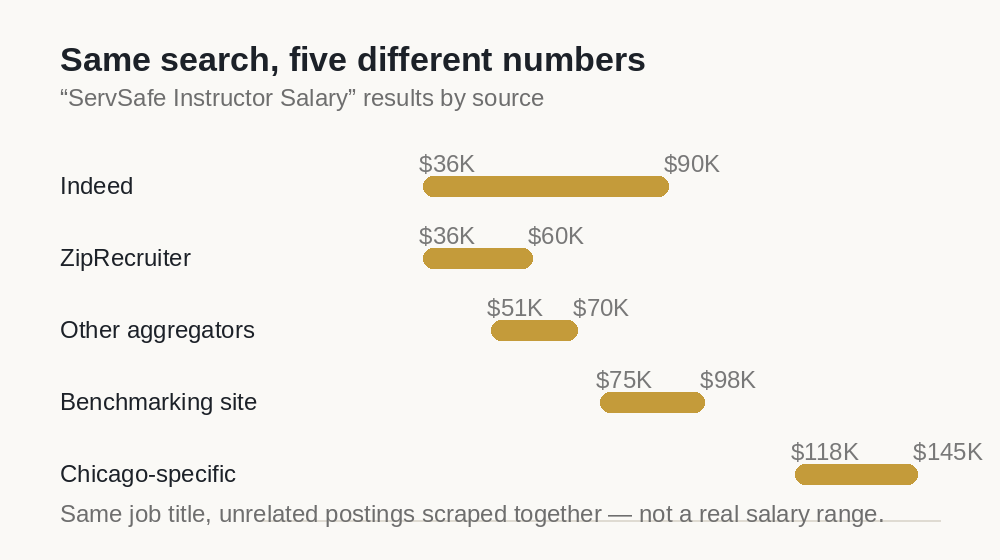
Search this term and you’ll get a different number depending on the site. That’s not five sources converging on an answer. Five keyword-matching algorithms are scraping five different mixes of unrelated postings for a job that doesn’t actually exist as its own category. Whatever number you saw before landing here, treat it as noise.
The math backs this up. Take a company with 30,000 employees. ServSafe Manager Certification isn’t required for the whole workforce — just managers and shift leads, typically around 5% of staff, or roughly 1,500 people. Factor in manager-level turnover and you land on a few hundred recertifications a year, not thousands. Outsourcing that volume to an outside instructor typically runs $30,000–$40,000. A full-time hire at $50,000–$60,000, plus benefits and payroll taxes, costs more to do the same job. So companies either outsource the certification or fold it into a role someone already has.
Two Real Paths, Not One
Instead of asking “what does a ServSafe instructor earn,” ask which of two real paths you’re on.
If you want to become an in-house instructor, there is a path for you — it generally means becoming a company trainer, a restaurant manager, a district manager, or the HR person. That’s who ends up holding the certification at most companies. It’s rarely a job called “ServSafe Instructor” on its own; the person wears the instructor hat on top of training, onboarding, compliance, and running a team. Their pay isn’t a separate number for teaching ServSafe. It’s whatever that actual job already pays, with the certification tacked on as one more responsibility.
One exception: a small number of standalone instructor positions exist at dedicated teaching and learning centers. These are rare, and they tend to go to food safety specialists with a specific background — former health department inspectors, auditors, and similar — not someone entering the field fresh.
The independent instructor teaches classes on their own, outside of any employer, and gets paid per student or per class. This is the only path where “instructor income” is really its own thing you can grow, because you’re not sharing a paycheck with a dozen unrelated duties. What starts as teaching a class on the side, advertised locally, can grow student by student into something that outpaces a full-time salary. It’s less about finding an employer who’ll pay more per hour. It’s about controlling your own class size, pricing, and schedule.
What Affects Your Earning Potential
If you’re building your own instructor business, these are the levers that actually move your income:
- Class size and frequency. One 8-person class a month earns very differently from four classes a week.
- Instructor and proctor certification. Holding both lets you keep the entire certification transaction instead of referring students out.
- Local demand. Areas with a high concentration of restaurants, food trucks, and hospitality businesses tend to support more consistent enrollment.
- Marketing and reputation. Instructors who are easy to find fill classes faster than those relying purely on referrals.
- Group and corporate contracts. Training a whole restaurant staff or corporate account at once beats filling one seat at a time.
Bottom Line
If you’re hoping to find a job posting for “ServSafe Instructor,” odds are you won’t — that responsibility almost always belongs to someone who was already a qualified HR person or trainer before the certification was added to their plate. But if you’re looking to build your own income around this certification, as a side hustle or a full replacement for your current job, that’s a real path — and it starts with getting certified and putting yourself in front of students.
See what that path could actually earn you → A free market analyzer shows realistic income for your area, plus everything you need to land your first client.